The First AI-Native ESG Intelligence Platform
Rethinking Sustainability Reporting in the Age of Artificial Intelligence
Sustainnovate.ai | Dubai, May 2026
For decades, sustainability has been treated as a reporting function. A quarterly obligation. Something organisations measure after decisions have already been made, in spreadsheets assembled under deadline pressure, with data collected too late to change anything.
Carbon emissions are calculated months after they occurred. Energy waste is identified in the annual report. Supply chain risks surface after damage has already been done. The frameworks multiply — UAE Climate Law, GRI, CSRD, DET, TCFD, ISSB — and with them, the manual workload.
Traditional sustainability software was not designed to solve this. It was designed to digitise the existing process. The result is a more organised version of the same problem.
Artificial intelligence changes the foundation, not just the interface.
AED 2M
Maximum penalty per violation under UAE Climate Law
Federal Decree-Law No. 11 of 2024 — full compliance due May 2026
28.2%
Annual growth rate of the global AI in ESG market to 2034
Market.us Research 2024 — sector reaching USD 14.87 billion
USD 1.2B
GCC cloud-based ESG reporting platforms market today
UAE leads regional adoption — Ken Research 2025
What AI-Native Actually Means
The term is used loosely. Here is what it means in practice.
A conventional sustainability platform asks a user to log in, enter data into fields, and generate a report. The intelligence is in the framework templates. The user provides everything else.
An AI-native platform inverts this. It reads the documents — utility bills, waste manifests, fuel logs, airline booking confirmations, HR exports — and extracts the data. It recognises that a DEWA electricity invoice contains the kWh figure that belongs to Scope 2 location-based emissions under GRI 305-2, the UAE Climate Law MOCCAE submission, the DET DST Carbon Calculator, and CSRD ESRS E1-4 simultaneously. It maps once. It reports to every framework.
It does not wait for the user to translate documents into data. It does the translation.
That is the difference between AI features added to a reporting tool and intelligence built into the data layer from the ground up.
The Problem Sustainnovate Was Built to Solve
A mid-sized UAE business typically reports against three or four ESG frameworks simultaneously. UAE Climate Law is a regulatory obligation. GRI is expected by international investors and procurement teams. DET requirements apply to every licensed hotel in Dubai. CSRD reaches into the supply chain of any business that supplies a large European company.
Each framework has its own terminology, its own granularity requirements, its own submission format. Scope 2 electricity in UAE Climate Law requires kWh by utility provider — DEWA, SEWA, ADDC separately. GRI 305-2 accepts a location-based total. The DET DST Calculator requires kgCO2e per occupied room night. CSRD wants the methodology documented.
The same underlying data — electricity consumption — needs to be structured four different ways for four different frameworks. In a manual process, this means four separate collection exercises, or a single collection that satisfies the most demanding framework and loses quality for the others.
Sustainnovate collects once and maps to every framework the organisation has selected. Nothing is collected twice.
The data enters the system once — through a bill upload, a template import, or a direct manual entry. The platform understands which framework needs what level of detail, at what granularity, with what evidence attached. The report generator draws from a single structured data layer.
How the Intelligence Layer Works
Document extraction handles the input problem. When a hotel uploads twelve months of DEWA bills, diesel delivery receipts, waste contractor manifests, and water tanker invoices, the platform reads them. It extracts account numbers, billing periods, consumption quantities, and units. It maps each figure to the correct metric and sub-metric — diesel to stationary or mobile combustion depending on the equipment declared, food waste separately from general waste because DET and GRI require them separately, water withdrawal broken out by source because GRI 303 requires it that way.
Each extraction carries a confidence score. A clean, structured utility bill from a major UAE utility extracts at high confidence. A handwritten fuel log photographs at lower confidence. The system flags the difference and routes low-confidence extractions to human review. The sustainability manager reviews and approves before any figure enters a report.
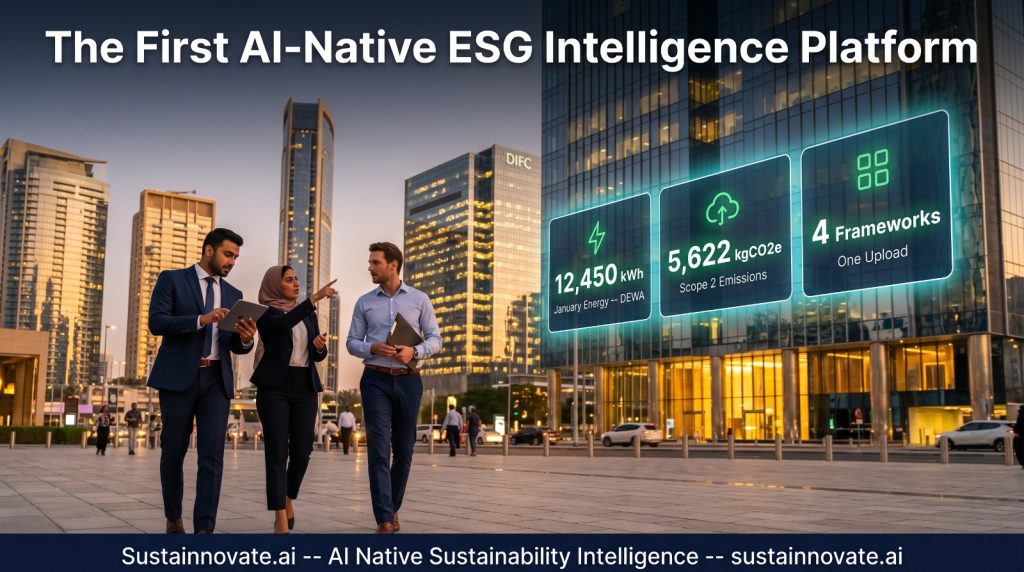
Evidence stays connected to values. When an auditor asks where the 12,450 kWh figure for January came from, the answer is one click — the source document, the extraction timestamp, the reviewer who approved it, and the carbon accounting calculation that converted it to tCO2e using the MOCCAE 2024 emission factor.
Carbon Accounting Built In, Not Bolted On
Emissions calculation is handled by a dedicated Carbon Accounting engine, not approximated by the reporting layer. Activity data — litres of diesel, kWh of electricity, kg of refrigerant, tonnes of waste — enters the system and is converted to tCO2e using current, jurisdiction-appropriate emission factors: MOCCAE factors for UAE utilities, IPCC AR6 GWP values for refrigerants, DEFRA factors for business travel.
The Metrics layer stores the result. The reporting layer reads it. The distinction matters: no part of the platform invents emissions figures. Every tCO2e in an output report traces back to a specific activity value, a specific emission factor, and a specific calculation.
For Scope 3, the platform covers all fifteen GHG Protocol categories. Categories with full data collection — business travel, upstream transport, waste in operations, employee commuting, purchased goods and services — calculate from activity inputs. Categories where clients currently have only pre-computed totals accept those totals with the appropriate transparency flag. The gap is noted, not hidden.
Qualitative Disclosures: The Half of ESG Reporting Nobody Has Solved Well
Quantitative metrics are roughly half of what GRI, CSRD, and UAE Climate Law require. The other half is qualitative — narrative disclosures about governance structure, climate transition plans, human rights due diligence approach, stakeholder engagement, materiality process, energy management policy, and more.
This half has been largely ignored by sustainability software. Platforms either leave it to the user entirely or produce generic template text that no auditor believes.
Sustainnovate approaches qualitative disclosures differently. The platform asks structured, framework-mapped questions. When a client answers that their board sustainability committee meets quarterly, that the CEO has a 15 percent ESG KPI in variable compensation, and that climate risk is formally on every board agenda, those structured answers become the input to an AI drafting process. The platform generates a disclosure in the register each framework expects: formal and evidenced for CSRD, principle-based for TCFD, topic-standard-structured for GRI.
The draft goes to a named human reviewer. It is approved or revised. The approved text enters the report. The AI-generated draft never publishes without human sign-off. The approval is recorded with a timestamp and a reviewer identity — because when a regulator asks who authorised the governance disclosure, the answer must be a person.
Framework Coverage Without Duplication
The platform currently supports UAE Climate Law and MOCCAE IEQT XML submission, GRI Standards 2021, DET Hotel Classification 2025 and DST Carbon Calculator, CSRD and ESRS, TCFD, ISSB S1 and S2, BRSR for India-linked businesses, and ADX ESG Disclosure requirements for Abu Dhabi listed companies.
The principle that governs the architecture is straightforward: one data set, multiple frameworks. A hotel collecting energy, water, waste, and emissions data for DET does not need to collect it again for UAE Climate Law or GRI. The frameworks ask for different granularity and different formats. The platform resolves those differences from the same underlying data.
Where frameworks diverge — where DET requires kWh by utility provider but GRI accepts a location-based total — the platform knows. It collects at the maximum required granularity and serves each framework what it needs. Clients are not asked to understand the technical differences between frameworks. They are asked to collect good data.
Completeness Before Submission, Not After
The most common ESG reporting failure is not inaccuracy. It is incompleteness discovered too late.
Sustainnovate runs continuous gap analysis against every framework the organisation has selected. As data arrives through the year, completeness updates in real time. When a DEWA bill is processed in March, the Scope 2 electricity node for Q1 moves from incomplete to complete. The framework mapping updates. The gap report shortens.
Three days before a DET submission deadline, the platform shows precisely what percentage of the 27 DET requirements are complete, which are partially filled, and which are genuinely missing — with enough specificity to act. Not just “waste data incomplete” but “food waste tonnage not collected separately from general waste — DET Req 15 and GRI 306-3 both require this breakdown.”
The organisations that benefit most from this capability are the ones that make data collection a monthly discipline rather than an annual event. The platform supports that discipline. It cannot substitute for it.
FOR THE GCC REGION, SPECIFICALLY
Sustainnovate is built for the regulatory environment in which UAE businesses actually operate — not adapted from a European or North American product.
The UAE Climate Law deadline of 30 May 2026 applies to all businesses operating in mainland UAE and free zones regardless of size or sector. The MOCCAE IEQT submission requires XML-format output with specific fields. Large emitters above 500,000 tCO2e must additionally register with NRCC and obtain ISO 14064-3 third-party verification. The platform knows these requirements and structures collection accordingly.
For hospitality clients, DET’s 27 sustainability requirements span energy, water, waste, biodiversity, staff training, guest engagement, sustainable purchasing, local community, accessibility, and Dubai cultural promotion. The DST Stamp — Bronze through Platinum — is becoming a visible competitive signal in corporate travel procurement. The platform covers all 27 requirements quantitatively and qualitatively.
For businesses with European supply chain exposure, CSRD’s reach into Scope 3 Category 1 means suppliers to large EU companies will receive structured ESG data requests. The platform is designed to prepare clients for those requests before they arrive.
The Honest Assessment
AI in sustainability reporting is most valuable when it is embedded in disciplined data collection — not applied as a last-minute correction to undisciplined processes.
Document extraction, qualitative drafting, multi-framework mapping, and gap analysis are accelerators. They accelerate what organisations are already doing. If what they are doing is collecting data monthly, reviewing it continuously, and maintaining an audit trail — the platform makes that faster, more accurate, and more useful across more frameworks simultaneously.
The organisations leading on ESG reporting are not the ones with the most sophisticated technology. They are the ones with the best data discipline, properly supported by technology designed for the frameworks they actually report against. That is what Sustainnovate was built to be.
SUSTAINNOVATE.AI — ONE DATASET. EVERY FRAMEWORK. COMPLETE COMPLIANCE.
Sustainnovate.ai is an AI-native ESG compliance and sustainability intelligence platform headquartered in Utrecht, with operations in Dubai and India. The platform supports UAE Climate Law, GRI, DET, CSRD, TCFD, ISSB, BRSR, and ADX reporting from a single data collection layer. sustainnovate.ai
Sources: UAE Federal Decree-Law No. 11 of 2024 (MOCCAE); Cabinet Resolution No. 67 of 2024 (NRCC); ADX ESG Disclosure Framework 2024; DET Hotel Classification Sustainability Requirements 2025; EU CBAM Implementing Regulation 2026; Market.us AI in ESG Market 2024; Ken Research GCC ESG Platforms 2025; PROI Worldwide Global ESG Report 2025; Kayrouz and Associates UAE ESG Reporting Requirements 2026; PwC UAE Climate Change Law Advisory 2025.